Costs & Budgeting
How Much Does It Cost to Build a House in Ghana in 2026?
2026 house construction costs in Ghana: cost per square metre, 2, 3 and 4-bedroom estimates, where the money goes and how to stay on budget.
Key takeaways
- In 2026 most homes in Ghana cost roughly GH₵3,500–GH₵8,500 per square metre to build, depending on location, structure and finishes.
- A standard 3-bedroom house of 110–140 m² in Greater Accra typically costs GH₵500,000–GH₵1.1 million all-in, covering the building, external works, fees and connections but not land.
- Finishes (tiles, doors, windows, kitchen, sanitary ware) can account for a third of the budget, and they are where costs most often run away.
- Material prices move with the cedi, so always work from a current, itemised Bill of Quantities (BOQ).
If you are planning to build in Ghana, the first question is always the same: how much will it cost? The honest answer is that it depends on size, location, design and, above all, finishes. But you can get surprisingly close with a few reliable numbers.
This guide gives you current 2026 figures, shows where the money goes, and explains how to keep your project on budget. All figures are indicative for Greater Accra as of October 2026 and exclude the cost of land.
The short answer: cost per square metre in 2026
The most useful way to estimate a build is by floor area. Multiply the total internal floor area of your home (in square metres) by a rate that matches the level of finish you want:
| Finish level | Indicative cost per m² (2026) | What it typically means |
|---|---|---|
| Basic | GH₵2,800–GH₵3,800 | Simple layout, sandcrete walls, standard aluminium roofing, ceramic tiles, local fittings |
| Standard | GH₵3,800–GH₵5,500 | Good-quality porcelain tiles, POP ceilings, quality doors and windows, mid-range kitchen |
| High-end | GH₵5,500–GH₵8,500+ | Complex design, large glazing, premium imported finishes, smart-home features |
Industry estimates for 2026 put most Greater Accra residential builds at around GH₵4,200–GH₵5,500 per m² for a standard specification. Building outside Accra can be slightly cheaper on labour and transport, but material prices are broadly similar across the country.
Estimated cost by house size
Using those rates, here is what common house types cost to build in 2026:
| House type | Typical floor area | Basic finish | Standard finish | High-end finish |
|---|---|---|---|---|
| 2-bedroom bungalow | 70–90 m² | GH₵200k–340k | GH₵270k–500k | GH₵390k–760k+ |
| 3-bedroom bungalow | 110–140 m² | GH₵310k–530k | GH₵420k–770k | GH₵600k–1.2M+ |
| 4-bedroom storey house | 200–280 m² | GH₵560k–1.06M | GH₵760k–1.54M | GH₵1.1M–2.4M+ |
| 5-bedroom luxury home | 350 m²+ | Not typical | GH₵1.3M–1.9M | GH₵1.9M–3M+ |
These are building costs only. Add roughly 10–30% for external works (boundary wall, gate, paving), professional fees, permits, utility connections and contingency, which is why a standard 3-bedroom home in Greater Accra typically lands at GH₵500,000–GH₵1.1 million all-in.
The ranges are deliberately wide. Two 3-bedroom houses of the same size can differ by hundreds of thousands of cedis depending on the roof design, window sizes, ceiling heights and the tiles and fittings you choose. That is why a detailed design and a Bill of Quantities matter so much.
Where the money goes
Every build is different, but a typical Ghanaian house budget breaks down roughly like this:
| Stage | Share of build cost | Includes |
|---|---|---|
| Substructure | 10–15% | Setting out, excavation, foundations, ground-floor slab |
| Superstructure | 25–30% | Columns, beams, blockwork, lintels, upper floor slabs, staircases |
| Roofing | 10–15% | Timber or steel roof structure, roofing sheets or tiles, gutters, fascia |
| Mechanical, electrical & plumbing | 10–15% | Wiring, sockets, lighting points, water supply, drainage, septic or sewer connection |
| Finishes | 25–35% | Plastering, screeding, tiling, ceilings, doors, windows, painting, kitchen, wardrobes, sanitary ware |
External works such as the boundary wall, gate, paving, drainage and landscaping are budgeted on top of the house itself (see the worked example below).
Notice how large the finishing stage is. Many projects in Ghana stall at "roof level" because the owner budgeted for the structure but underestimated finishes. Plan for them from day one.
What drives the cost up (or down)
1. Design complexity
Every corner, cantilever, curved wall and change in roof level adds labour and materials. A simple rectangular plan with a straightforward roof is the most economical shape to build. Good architects can still make a simple plan look striking, as our guide to house designs that suit Ghana's climate shows.
2. Storey vs bungalow
A two-storey house uses less land and roofing per square metre but needs suspended slabs, stronger columns and a staircase. On a cheap, large plot, a bungalow may cost less per m²; on an expensive urban plot, building up is usually better value.
3. Soil and site conditions
Sloping sites, clay soils or a high water table can require deeper foundations, retaining walls or raft foundations. A simple soil assessment before design avoids nasty surprises.
4. Finishes and fittings
Imported tiles, large aluminium windows, solid doors and designer sanitary ware can double the cost of the finishing stage. Choosing where to spend (living areas, master suite) and where to save (secondary bedrooms, boys' quarters) is the single most powerful budgeting tool you have.
5. Material prices and the cedi
Cement, iron rods and roofing sheets all have imported inputs, so their prices follow the exchange rate. Check our latest building materials price guide and buy key materials early when prices are favourable.
6. Who manages the build
Managing artisans yourself can look cheaper, but wastage, theft, rework and delays often wipe out the savings, especially if you are building from abroad. A design-and-build contractor with a fixed, itemised BOQ gives you cost certainty.
Costs people forget to budget for
- Professional fees: architectural and structural drawings, surveying and, where needed, a soil test.
- Building permit fees: charged by your Metropolitan, Municipal or District Assembly. See how to get a building permit in Ghana.
- Utility connections: ECG electricity meter, Ghana Water connection or a borehole, and septic or sewer connection.
- Boundary wall and gate: often a significant cost on its own.
- Contingency: set aside 10% for unforeseen items and price changes.
How to keep your build on budget
- Start with a detailed design. Changes on paper are free; changes on site are expensive.
- Get an itemised BOQ. It lists every material and quantity so you can compare contractor quotes fairly and track spending.
- Fix your finishes early. Choose tiles, doors and sanitary ware before construction so they are priced into the budget.
- Build in logical phases if funds are limited, and always protect the structure (roof on) before pausing.
- Pay against milestones, never far ahead of the work actually completed.
- Buy bulk materials early when prices are stable.
Worked example: budgeting a 3-bedroom bungalow
Let's put the numbers together for a common project: a 120 m² three-bedroom bungalow with standard finishes in Greater Accra, using a mid-range rate of GH₵4,500 per m².
| Item | How it's calculated | Indicative cost |
|---|---|---|
| Substructure | ≈14% of house cost | GH₵75,000 |
| Superstructure | ≈29% of house cost | GH₵157,000 |
| Roofing | ≈13% of house cost | GH₵70,000 |
| Mechanical, electrical & plumbing | ≈14% of house cost | GH₵76,000 |
| Finishes | ≈30% of house cost | GH₵162,000 |
| House (building) cost | 120 m² × GH₵4,500 | GH₵540,000 |
| Boundary wall, gate, paving & drainage | Allowance | GH₵50,000–90,000 |
| Drawings, survey and permit | Allowance | GH₵25,000–45,000 |
| Electricity, water and septic connections | Allowance | GH₵10,000–25,000 |
| Contingency | 10% of house cost | GH₵54,000 |
| Estimated all-in total (excluding land) | ≈ GH₵680,000–755,000 |
Your own numbers will differ, but working through a table like this, line by line, is exactly how a quantity surveyor builds a reliable budget.
Building in phases: a sample plan
Many families in Ghana build as funds become available. That works well when each phase ends at a safe stopping point:
| Phase | Work included | Approx. share of house cost |
|---|---|---|
| 1. Foundation | Setting out, excavation, foundations, ground-floor slab | 12–15% |
| 2. Walls | Columns, blockwork, lintels, ring beam to roof level | 25–30% |
| 3. Roofing | Roof structure, covering, gutters | 10–15% |
| 4. Services & plaster | Wiring, plumbing, plastering, screeding, window frames | 15–20% |
| 5. Finishes | Tiles, ceilings, doors, windows, kitchen, wardrobes, paint | 25–30% |
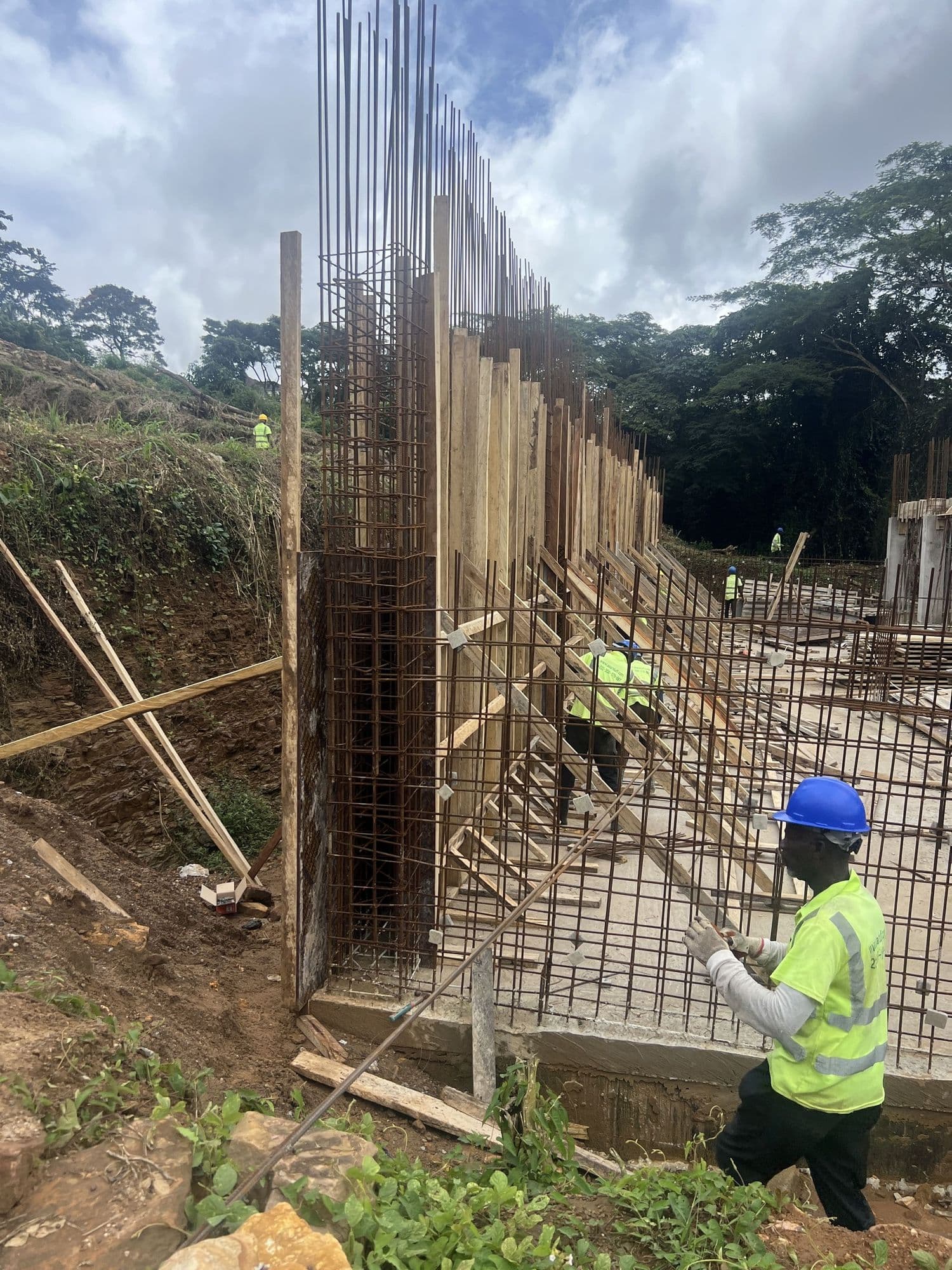
Avoid leaving walls half-built through a rainy season, protect exposed reinforcement bars from rusting, and keep the site secure between phases. Getting the roof on as early as possible protects everything you have already paid for.
Does location change the cost?
- Greater Accra has the highest labour rates and land prices, and traffic can slow deliveries.
- Kumasi and the Ashanti Region often have slightly lower labour costs, but hilly sites can add foundation and retaining-wall costs.
- Coastal cities such as Takoradi, Tema and Cape Coast benefit from corrosion-resistant roofing and fixings, which cost more.
- Northern Ghana may pay more to transport some materials, and designs should invest in shading and insulation to cope with heat.
See our local guides for Accra, Kumasi, Takoradi and Tamale.
Bungalow or storey building: which is cheaper?
For the same floor area, a bungalow avoids suspended slabs, stairs and heavier columns, so it is often cheaper per square metre, but it needs a larger plot and more roofing. A storey building uses land efficiently, which matters when land is expensive, and can give better views and security. On a tight urban plot in Accra, building up is usually the better-value choice; on a large, affordable plot, a bungalow may win.
How Rumah Kreatif can help
We start every home with an itemised Bill of Quantities, so you know exactly what your house will cost before a block is laid. Our residential construction service then delivers the build in clear milestones with weekly photo and video reports. If you are still at the planning stage, our permits, costing and consultation service will give you an independent estimate for your design.
Ready to put real numbers on your plans? Request a free quote and tell us about your land and the home you want to build.
Frequently asked questions
How much does it cost to build a 3-bedroom house in Ghana?
A standard-finish 3-bedroom house of 110–140 m² in Greater Accra typically costs GH₵500,000–GH₵1.1 million all-in in 2026 (building, external works, fees and connections), excluding land. The building alone is usually GH₵420,000–GH₵770,000. Basic finishes can bring this lower; luxury finishes, larger footprints or storey buildings push it higher.
What is the cost per square metre to build in Ghana?
Indicative 2026 rates are about GH₵2,800–GH₵3,800 per m² for basic finishes, GH₵3,800–GH₵5,500 per m² for standard finishes and GH₵5,500–GH₵8,500+ per m² for high-end finishes.
Is it cheaper to build or buy a house in Ghana?
Building is usually cheaper than buying a comparable finished home from a developer, because you avoid the developer's margin and marketing costs. Buying is faster and lower-risk if you lack time to manage a build. A design-and-build contractor gives you much of the cost advantage with less of the hassle.
Does the cost include land?
No. Land is a separate and highly variable cost, ranging from a few tens of thousands of cedis in peri-urban areas to several million in prime Accra neighbourhoods.